

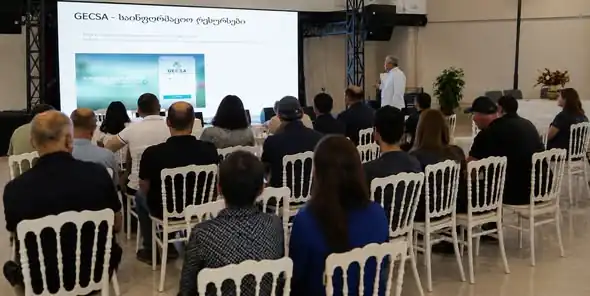

An information meeting about the GECSA digital platform was held for local farmers in the city of Gori. It was organized by the Agricultural Scientific-Research Center of Georgia.
The Scientific Research Center for Agriculture (SRCA) of Georgia shared glimpses of the information meeting on its official Facebook Page on August 5, 2026, Wednesday. A small note about the meeting was also shared along with its glimpses.
The purpose of the meeting was to explore the platform’s capabilities, provide information on climate risks, plant diseases, and pest prediction mechanisms, and promote informed decision-making in agriculture using modern digital services.
During the meeting, the participants were introduced to modern approaches to timely detection, prevention, and effective management of major diseases and pests of crops. They also received information about the functionality of the GECSA digital platform, which allows farmers to receive timely and practical recommendations based on the forecast of climate risks, plant diseases and pests.
The meeting brought together local farmers, agricultural experts, and development partners to discuss the growing role of digital technologies in modern farming. Participants were encouraged to adopt innovative tools that can improve crop management, strengthen climate resilience, and support sustainable agricultural practices through data-driven decision-making.
The event was led by Nodar Khatiashvili, Deputy Director of the Agricultural Scientific and Research Center, Zviad Bobokashvili, the Center’s Agronomist, Ilia Mchedlidze, and UN Development Program (UNDP Georgia) Representative Eduard Shermadin.
GECSA is a digital agro-platform developed in partnership with the United Nations Development Program (UNDP Georgia) and the Agricultural Scientific and Research Center, in the framework of the program “Expansion of early warning system of multifaceted threats and use of climate-related information”. The platform provides farmers with real-time information about pending climate threats, plant diseases, and pest risks, enabling timely and effective agronomic decisions.

