

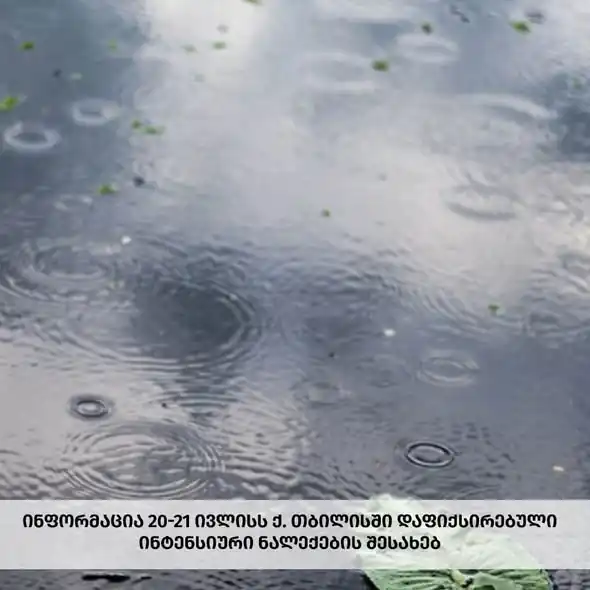

From the night hours of July 20, 2026, to the morning of July 21. In most areas of Tbilisi, severe rainfall and hazardous meteorological events were marked, resulting in flooding of streets in some areas of the city and temporary overload of urban infrastructure.
According to the meteorological observations of the National Environment Agency, the highest rate of rainfall was recorded in the area near the I building of Tbilisi State University, where 110 mm of rainfall fell over about 8 hours, which caused flooding in the city. Throughout Tbilisi, this is a record indicator for July. In addition, in 1 hour (20.07.23:00-21.07.00:00), more than half of this amount was recorded: 54.5 mm, which is 30% higher than the July climate norm for Tbilisi.
According to the meteorological stations of the Agency, the amount of precipitation at Tabakhmeli station is 25.07 mm, at Vashlijvari station 55.8 mm, at Bagebi station – 75.2 mm, at Sokhumi University station – 69.1 mm, at Mkhattskaro station – 87.3 mm, at Mtskheti station – 1.5 mm, and at Agmashbebeli Avenue it was 95.1 mm.
According to these data, rainfall was unevenly distributed throughout the city, a characteristic of convective processes. A particularly large amount of rainfall was recorded in separate districts of the western and central parts of Tbilisi.
During the day, significant heating of surface air, high volume of ten in the lower atmosphere and relatively cold air invasion in the upper layers, caused strong atmospheric instability. In such conditions, powerful convective clouds developed rapidly, which caused heavy rain in a small area in a short period of time.
During such events, the majority of the precipitation is characterized by the arrival of several hours. In this case, for about 7-8 hours, the amount of rainfall was 1.5 times more than the monthly normal, and in individual districts 2.5 times more. Such high intensity of rainfall is one of the main reasons for waterfalls, street flooding, and urban infrastructure overload.
It is noteworthy that climate change increases not only the frequency of extreme rainfall but also its intensity. Therefore, there are more frequent cases of heavy rainfall in a short period of time, increasing the risk of flash flooding and other hydrometeorological events.
The National Environment Agency continues to monitor hydrometeorological conditions continuously and promptly informs the population of impending hazards.
Information and warnings about expected weather and hydrometeorological threats can be found on the early warning mobile platform of the National Environment Agency: METEO.GOV.GE.

