

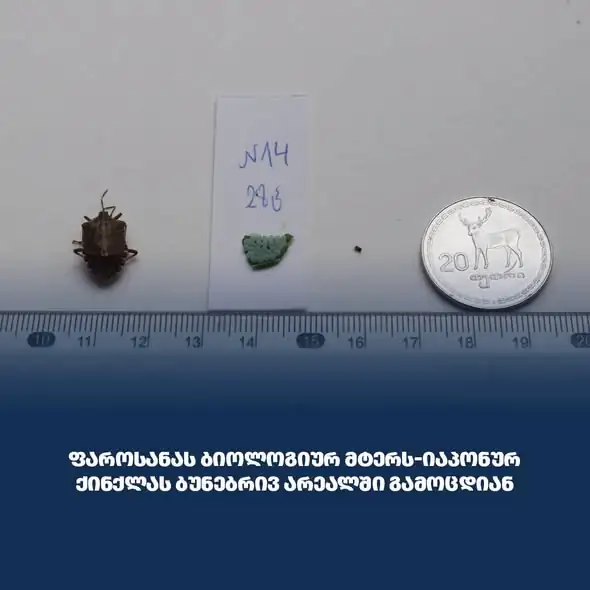

The natural enemy of farosana – Japanese Kinkla- specialists of the National Food Agency and Scientific Research Center will experiment in a natural environment.
Specialists of the Anaseuli Laboratory of the National Food Agency and Scientific Research Center have started to test the natural enemy of the Asian turtle, the Japanese kinkla (Trissolcus japonicus), in field conditions.
More than 30 thousand Japanese kinkles were discharged at 370 specially selected locations, where chemical drugs against Asian smallpox are not used. Specialists will observe the spread of insects and their impact on the population of taro in a permanent mode.
“In , the state holds unprecedented measures against the Asian pharaoh.” At the same time, like the world’s leading countries, we are actively working on the development of biological control methods. The Japanese kinkla is one of the most promising biological insects in this area, but it requires long-term observation to evaluate its effectiveness and ability to manage tamaGeorgiarind populations. Many countries around the world are learning this process today,” said Zurab Lipartia, deputy head of the National Food Agency.
Japanese kinkla specialists discovered it for the first time in Georgia in 2023 in Zugdidi municipality. Later, it was confirmed by scientists at the University of Turin. Following this, with the support of the National Food Agency, the appropriate infrastructure was established in the Anaseuli Laboratory of the Scientific and Research Center, active cooperation with Swiss, Italian, and Turkish scientists was started, and Japanese kincla reproduction and its phytosanitary risk assessment were carried out in laboratory conditions.
Georgian scientific studies, as well as international experiences, have shown that Japanese kinkla does not have a negative effect on beneficial insects. About one millimeter-sized parasitic insect lays eggs in Asian turtle eggs, causing a new generation of pests to stop developing.
That’s why the Japanese kinkla is today considered one of the promising means of biological control against the Asian shield. Launching it into its natural environment and evaluating its effectiveness is already underway in Switzerland, Italy, the USA and Turkey.

