

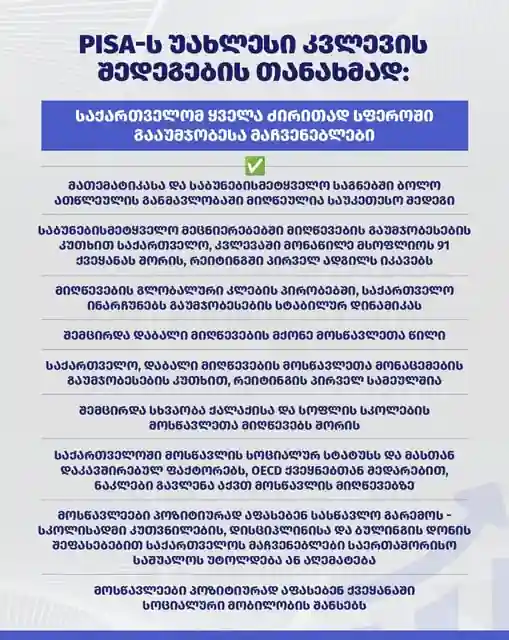

The results of the PISA 2025 study have been published, according to which, compared to the results of the 2022 study, Georgia has improved its indicators in all key areas – in mathematics and natural sciences, the best results have been achieved over the past decade.
The study showed that:
- Georgia ranks first among the 91 countries participating in the study in terms of improving achievements in natural sciences;
- In the context of a global decline in achievements, Georgia maintains a stable trend of improvement and positive dynamics – the international trend is a decline in results in all three areas; in contrast, our country has improved its achievements;
- The share of students with low achievements has decreased, which means that compared to previous years, fewer students received low results in 2025.
- Georgia is in the top three out of 91 countries in terms of improving the data on low-achieving students;
- The gap between the achievements of students in urban and rural schools has decreased, which is one of the factors in ensuring equality. It is noteworthy that the achievements of students in rural schools in the fields of natural sciences and mathematics have increased;
- In Georgia, the social status of a student and the factors related to it have less influence on student achievements, compared to OECD countries, which is a clearly positive indicator. In particular, in Georgia, compared to the international indicator, the share of “outstanding students” is higher; these students, despite their low socio-economic status, show high results in the PISA test;
- The study revealed that students positively assess the learning environment. According to the survey results, in terms of the learning environment – school affiliation, discipline, and bullying levels, Georgia’s performance is equal to or exceeds the international average;
- Students positively assess the chances of social mobility in the country;
- According to the 2022 results, the pandemic has had a negative impact on the achievements of countries, although, unlike the international trend, Georgia’s performance has not changed significantly. It has only slightly decreased in reading, which is a global trend today;
In 2025, the main area of assessment was natural sciences. If we look at the comparison of countries and economies, based on the indicator of student achievement in natural sciences, we will see that Georgia is lagging behind countries such as:
- Bulgaria
- Moldova
- Kazakhstan
- Malaysia
- Cyprus
- North Macedonia
- Armenia
- Azerbaijan
- Brazil
- Argentina and others.
It is worth noting that while 81 countries of the world participated in the previous 2022 PISA study, the number of countries in the 2025 study increased to 91, which makes Georgia’s achievements more impressive.
The 2025 assessment is the ninth cycle. PISA was conducted every three years, and since 2025, the duration of the PISA cycle has increased to 4 years.
The Programme for International Student Assessment (PISA) has been conducted since 2000 under the auspices of the Organisation for Economic Co-operation and Development (OECD). Georgia first participated in PISA in 2010.
PISA assesses the readiness of 15-year-olds to face the challenges of adult life. The main areas of assessment are: reading, mathematics, and natural sciences.

