

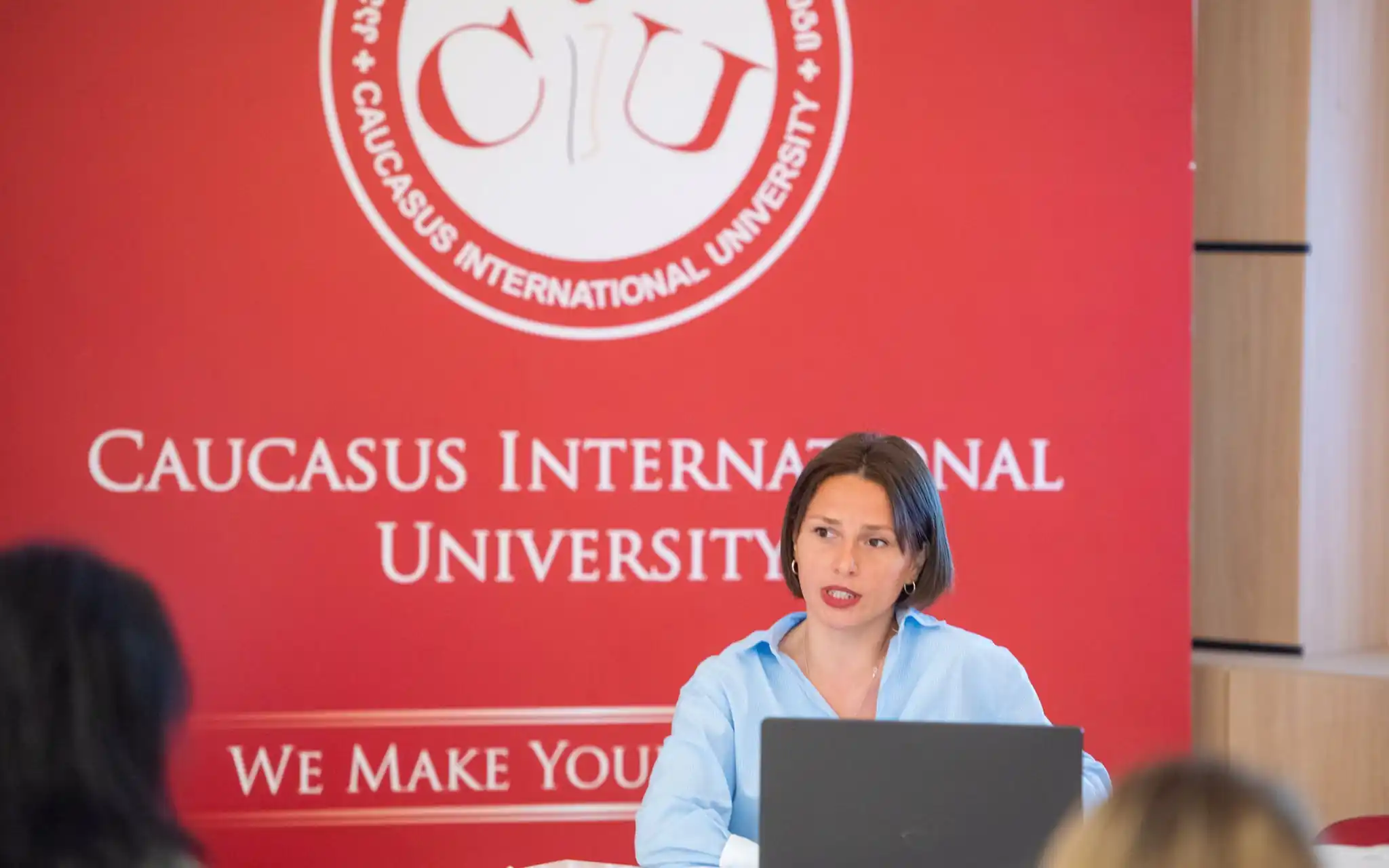

Caucasus International University actively continues to promote the development of the educational process and the professional growth of academic staff. For this purpose, a training was held in the university, which was dedicated to cooperative teaching methods and strategies.
The meeting was led by Tamar Panchulidze, an expert on the implementation and development of the third-generation national curriculum.
The event emphasized that collaborative learning is the most modern form of education, which lecturers and teachers are increasingly integrating into the learning process. This approach focuses on teamwork, which requires students to use synchronous or asynchronous, coordinated, and constructive activities to jointly solve problems and achieve a common goal.
The expert introduced the training participants to the main principles of cooperative learning: positive interaction, which means uniting around a common goal; individual responsibility, where each team member contributes his/her contribution to the common cause; promoting face-to-face interaction; developing social and cooperative skills; and evaluating the group process, which is self-established. It is based on the mechanisms of reflection.
After the theoretical part, the discussion continued in the practical section: How can lecturers apply these approaches directly to the audience? In this context, specific strategies were discussed, such as the interactive method “think, pair, share”, “collecting ideas” (so-called puzzle), and proper division of roles in a team. Pay attention to the segmental method, which means to divide the study material into parts, and students acquire it step by step.
One of the training blocks was dedicated to the criteria for effective management and evaluation of group work, during which participants shared practical cases and digital tools from leading universities worldwide. In particular, a method of research approved at Harvard University was reviewed, which confirms that the most effective in group work is the so-called progressive assessment. Also, the MIT approach actively uses the team agreement document during group projects.
Based on the practice of European universities, the importance of the three-component assessment matrix is emphasized; according to the international standard, the assessment should be three-sided in order to reflect objectively and fairly on the final mark of each student.
The meeting was held in an interactive format, based on question-and-answer and active discussion. The training was organized by the Caucasus International University Staff Management Service / Continuing Education and Career Development Service.

