

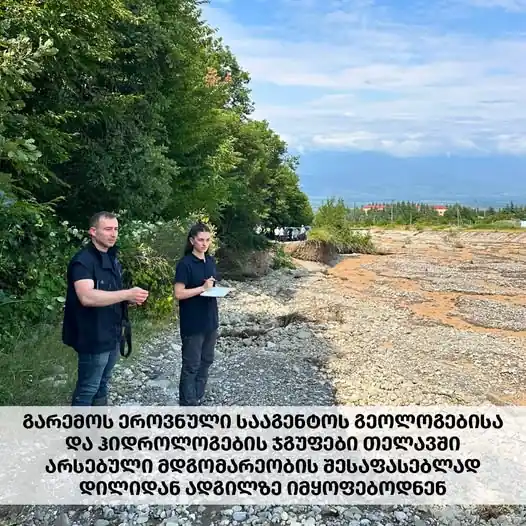

As a result of heavy rainfall in Telavi, the stream of the Telavi River broke its banks, and the gvartsophile stream flooded several streets of the city on July 12.
The LEPL National Environmental Agency of Georgia shared glimpses of the overflow caused by heavy rainfall in Telavi on its Official Facebook Page on July 12, 2026, Sunday. The Agency also shared a small note about it along with its glimpses.
According to the meteorological stations of the National Environment Agency, the amount of precipitation at Telavi station was 57.3 mm, which is 85% of the monthly norm of Telavi, and 40.1 mm at the station.
A group of geologists and hydrologists from the National Environment Agency has been on site since morning to assess the situation in Telavi.
According to the preliminary assessment, the heavy atmospheric rainfall in the Telavi municipality has caused the drastic activation of the sinking processes in the Telavikhevi river basin.
The combination of solid natani and critical water mass formed a powerful gvartsophile stream. Three garbage dumps (so-called Kherkheulidze’s dam) located in the middle of the river provided the filtration of the stream partly: the first almost completely contained thick wood-wood material, the second – a small amount of wood-wood, and the third – a stone-gravel fraction. Nevertheless, the large volume and energy of the outflow bypassed all three debris from the left side, temporarily used the old soil road as a ditch, damaged the frontline debris, and caused deformation of the cover on individual sections of the road.
In the area of the city, the river bank could not provide the full flow of the gvarts and moved to the nearby area. The main accumulation of Gvartsophuli mass in the lower part of Telavi was found near individual infrastructural objects.
Specialists of the National Environment Agency remain on site and continue to study the area in detail.

